
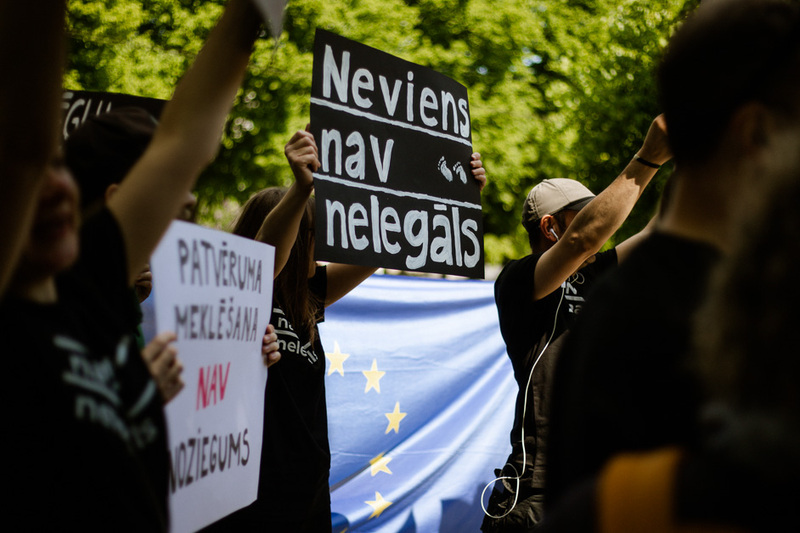
The words “illegal migrant” or “illegal migration” are often used when referring to the situation on the Latvian-Belarusian border. This approach should be seen as stereotyping, which the association “I want to help refugees” has addressed to the Ombudsman for the Public Media, here is the Ombudsman’s opinion. It should be noted that not only do people attempting to cross the EU’s external borders predominantly become asylum seekers, but the very term “irregular migrant” is recognised as undesirable (see, for example, the International Organisation for Migration Migration Glossary https://publications.iom.int/system/files/pdf/iml_34_glossary.pdf).
The word “illegal” is associated with the commission of a criminal offence – crossing the border illegally in Latvia is a criminal offence. But if people apply for asylum after crossing the border illegally into Latvia, they are not penalised. The provisions of the Act of 1951 on the Article 31(1) of the Convention relating to the Status of Refugees of 28 July 1967 and its Protocol of 31 January 1967 provides that “A Member State shall not punish refugees on account of their illegal entry or presence if they have come directly from a territory where their life or freedom was threatened […] and have applied without delay to the national authorities, showing good reasons for their illegal entry or presence”. In several other EU countries, it is an administrative rather than a criminal offence to stay without a legal basis.
Most of the persons who have come to Latvia from Belarus are asylum seekers, so until a decision is taken on their status, they should be called asylum seekers, despite the fact that the border was crossed illegally.
The term “irregular migrant” is not only undesirable, but also denigrates the human rights of all migrants and is not in line with good practice. Instead, we call for people crossing the border to be referred to by neutral terms such as “border crosser”, “alien” or “migrant”, if it is not possible to use the catch-all term “human”. We also call for the use of the term “illegal immigration” to be discontinued in order to contextualise the situation. People admitted for humanitarian reasons to the territory of Latvia are mainly from countries – such as Syria, Afghanistan, Iraq, or Iran – that cannot be considered safe at least in part of their territory.
From a legal and ethical perspective, a process or an act can be described as illegal, but not a person. No one is illegal!
This material has been produced with the support of Iceland, Liechtenstein and Norway under the EEA and Norway Grants Programme “Active Citizens Fund”. The content of this publication is the responsibility of the association “I want to help refugees.